

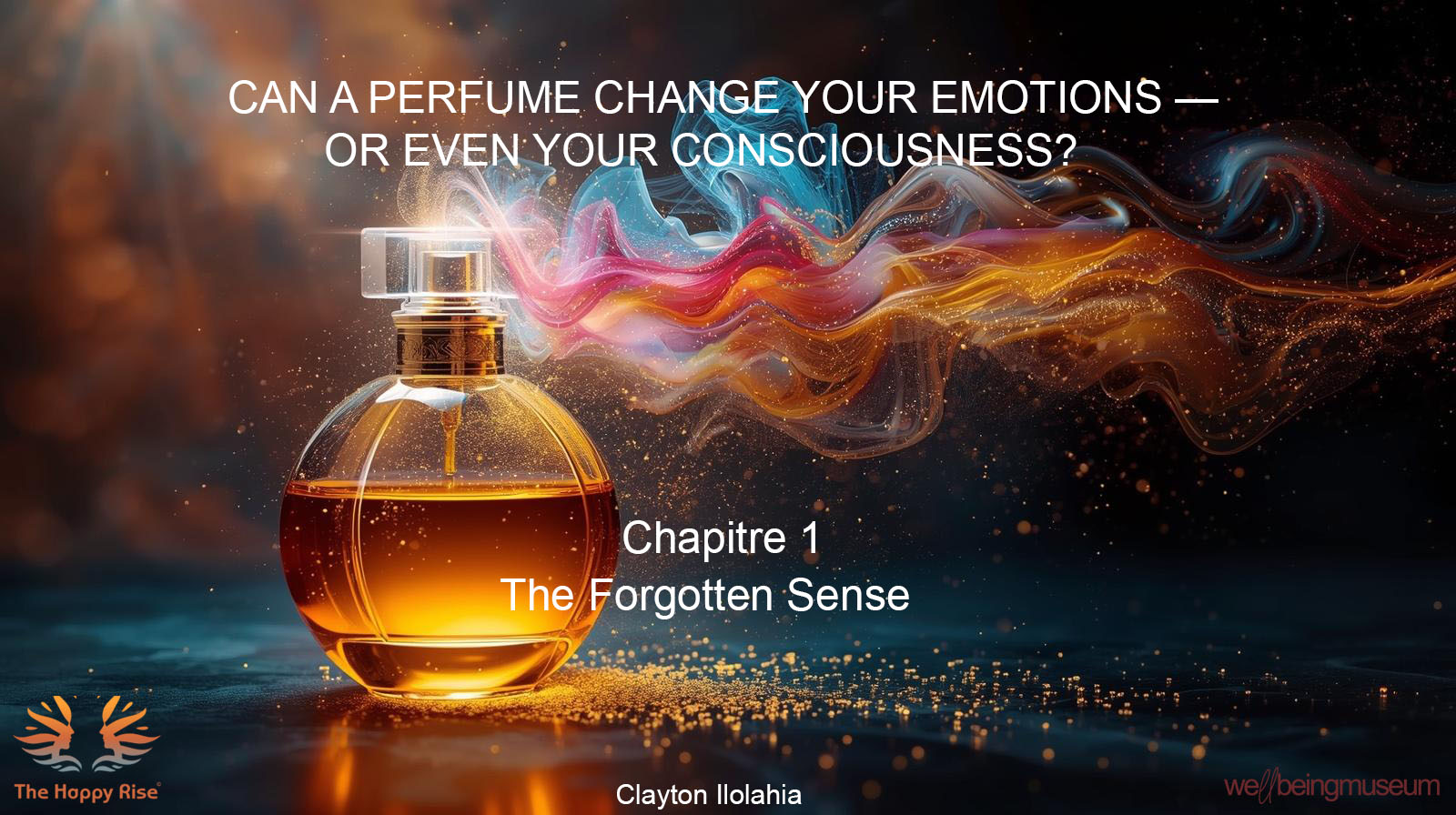
Can a perfume change your emotions — or even your consciousness? The question sounds bold, perhaps even extravagant. But science, art, and centuries of human experience suggest it is entirely serious. Over the course of this series, we will explore how the simple act of smelling something can reach places that words, images, and music simply cannot. This first chapter begins at the beginning: with the sense itself, long neglected, and the remarkable world that opens up the moment we decide to pay attention to it.
A sense left behind by history
There is something quietly extraordinary about a faculty most of us take for granted. Of the five human senses, smell remains the most mysterious — the one that travels fastest to memory, to emotion, to that fragile thing we call well-being. Long dismissed in Western culture as the most primitive of the senses, it has been quietly working on us all along, shaping how we feel, what we remember, and who we become.
Why smell is the most powerful sense you’ve been ignoring
The ancient Greek philosophers noticed how powerfully animals were governed by smell — and decided that humans should rise above it. That philosophical choice, made thousands of years ago, echoes through education systems to this day. We are not taught to smell. We are not given a vocabulary for it. We are not encouraged to notice it. And yet, neuroscience tells us that the olfactory system is uniquely wired to bypass the cortex — the brain’s center for logic and rational thought — and connect directly to the ancient limbic system, the seat of memory and emotion. Every other sense passes through the newer brain first. Smell does not. It arrives instantly, whole, and unfiltered.
This is why a single scent can collapse time entirely. Unlike the chronological storytelling of film or literature, smell delivers everything at once — images, feelings, seasons, people — overlaid and simultaneous, like a chord rather than a melody. That instantaneous quality makes fragrance one of the most powerful tools available for accessing the emotional and psychological dimensions of well-being. Not through effort or intention, but automatically, the moment a molecule reaches a nerve.
What childhood fields teach us about scent
The journey toward truly understanding this begins long before any professional encounter with fragrance. It begins in childhood — in fields, in gardens, in the specific quality of air in a specific place.
Growing up in open country, surrounded by animals and very few human neighbors, shapes a child’s attention in a particular way. The imagination, left to roam freely, anchors itself to the senses. The smell of warm summer grass — still air, no wind, the golden stillness of a long afternoon — leaves an impression that no classroom could manufacture. That scent, now identified as a coumarin molecule and found in many beloved fragrances, is at its origin simply the memory of a calm day. It is the smell of safety, of solitude, of physical and emotional well-being experienced without yet having words for it.
Can a perfume change your emotions — or even your consciousness?
Beyond the grass, there are the rich, layered smells of a working farm — animals, earth, water, things decaying and things growing. A lake nearby, with watercress and the cold freshness of snowmelt. The particular scent of daffodils on a winter morning, a flower that somehow carries both chill and sweetness at the same time — a paradox the nose absorbs without question, even as the mind struggles to articulate it. These early sensory experiences, unedited and deeply embodied, become the raw material of a lifelong relationship with smell. They are also the foundation of a form of well-being rooted in presence: the ability to be fully in a place, alive to every invisible signal it offers.
How to start listening again
Developing this awareness is available to everyone. It requires no special gift — only attention. The sense of smell, long neglected, is extraordinarily responsive to practice. Simply remembering to smell your environment — a restaurant, a street, a room before sitting down — is enough to begin reactivating a faculty that modern life has quietly trained us to ignore.
The difficulty many people experience in putting smell into words is not a failure of the nose. It is the natural result of using two very different parts of the brain simultaneously: the ancient, emotional brain where the scent arrives, and the modern, verbal brain where language lives. The gap between those two places is real. Forgiving yourself for it is the first step toward a richer, more conscious engagement with the world.
That engagement, once cultivated, quietly transforms everyday life. It deepens social well-being — sharpening awareness of people, places, and moments that might otherwise blur past unnoticed. It nourishes intellectual well-being, inviting curiosity about what the nose detects and why. And over time, it opens a door to something broader: a more conscious, more present way of inhabiting the world.
Because the world is already speaking to us in scent. The only question is whether we are listening.
This article was inspired and written following an enriching exchange with Clayton Ilolahia
Related Post

Quand on vit une vie qui ne nous ressemble plus
Il arrive parfois que tout semble aller bien en

Et si derrière une croyance se cachait une peur invisible ?
Nous avons tous des croyances qui influencent notre manière
Raphaël
5 mai 2026 at 14h07Magnifique réflexion ! L’idée que l’odorat est un accord plutôt qu’une mélodie change totalement ma perception de mon parfum matinal.