

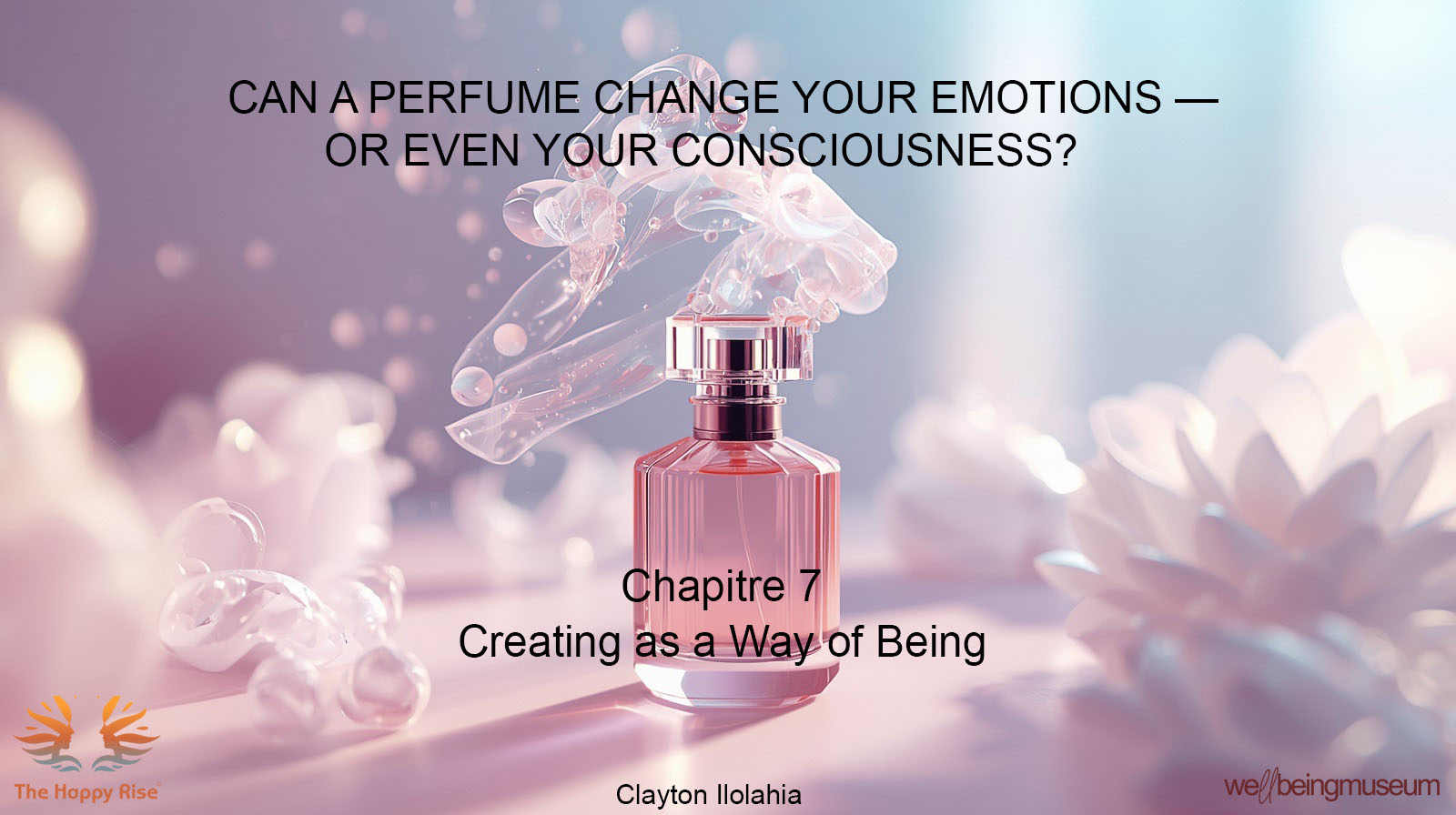
Can a Perfume Change the Way You Feel?
There is a particular kind of clarity that arrives, sometimes after decades, when a person is finally ready to return to the thing they always meant to do. Not with the urgency or inexperience of youth, but with the accumulated wisdom of everything that has happened in between — every detour, every unexpected collaboration, every period of professional well-being and personal growth that the zigzag made possible. That return is not a retreat. It is a homecoming. And it carries a quality of focus and intentionality that only time and experience can produce.
Returning to the Original Intention
For those whose creative life intersects with the world of fragrance, that homecoming often means returning to the original question: what does it mean to create a scent not as a commercial product, but as a genuine artistic act? The two ambitions are not always incompatible, but they are not the same. A fragrance designed to sell follows the logic of the market — it anticipates desire, it speaks a recognizable language, it arrives already legible. A fragrance designed as art follows a different logic entirely. It asks questions rather than providing answers. It may be challenging, unfamiliar, even deliberately uncomfortable. It exists not to be worn, necessarily, but to be experienced — to open something in the person encountering it, to touch the edges of consciousness in ways that more conventional beauty cannot reach.
When a life zigzags long enough, the most powerful move is to come back to the beginning
The intersection of visual art and olfactory art is, in this sense, one of the most fertile creative territories available to contemporary artists. When scent is placed alongside image, when the invisible and the visible are allowed to speak to each other, the result can reach dimensions of general well-being that neither medium could access alone. Exhibitions that incorporate fragrance invite the audience into a fully embodied experience — one that engages not just the eye and the mind, but the ancient, emotion-linked faculty of smell that bypasses rational thought entirely. In that space, art becomes something more than observation. It becomes encounter.
In a world of accelerating uncertainty — where the future feels genuinely difficult to predict and the pace of change seems to outrun the capacity for reflection — the commitment to creativity as a daily practice is itself a form of well-being. Not productivity, not output, not the performance of creativity for an audience, but the quiet, focused act of using the creative mind simply because it brings joy. That joy, returned to regularly and protected deliberately, is one of the most reliable anchors available to anyone navigating an unstable world.
Creativity, presence, and the courage to follow joy — the deepest form of well-being
In the end, the question of well-being — what it means, how it is found, how it is maintained — does not resolve into a single answer. It unfolds, like a great fragrance, in successive layers. What reveals itself first is not necessarily what lasts. And what lasts is rarely what was expected.
The path forward, for anyone genuinely interested in living well, involves all of the things this conversation has touched: the willingness to pay attention, to slow down, to trust the body’s responses, to create with intention, and to return, again and again, to the things that produce genuine joy rather than merely the appearance of it. Creativity, understood in this way, is not a luxury reserved for artists. It is a fundamental dimension of a fully human life — and one of the most direct paths available to the kind of well-being that endures.
The Complete Series: A Synthesis
Seven Chapters, One Conversation — The Logical Arc of Scent and Well-Being
This series was built around a single, deceptively simple question: can a perfume change your emotions — or even your consciousness? Over seven chapters, the answer has revealed itself not as a fact to be stated, but as a territory to be explored — one that touches every dimension of human well-being, from the most intimate to the most universal.
Chapter 1 — The Forgotten Sense established the foundation. The sense of smell, dismissed by ancient philosophy and neglected by modern education, is in fact the most direct pathway to emotion and memory available to human beings. Understanding this — truly understanding it, not just intellectually but experientially — is the beginning of a richer relationship with one’s own inner life. General well-being, it turns out, begins with paying attention to something most of us have learned to ignore.
Chapter 2 — Scent, Soul, and Self deepened that foundation by exploring the emotional and spiritual dimensions of olfactory experience. Scent, understood as a form of self-knowledge, becomes a tool for psychological well-being — a way of accessing the ancient, feeling brain that rational thought so rarely reaches. The chapter also examined how the same power that makes smell so personally meaningful makes it so commercially exploitable, and why navigating that tension with awareness matters.
Chapter 3 — Wearing Your Mood brought the conversation into practical territory. The fragrance wardrobe — the deliberate practice of choosing different scents for different emotional states — is not a superficial indulgence. It is an active, intentional approach to emotional and affective well-being, one that treats fragrance as a genuine tool for shaping inner experience rather than simply projecting an image. The chapter also examined the spiritual origins of perfume, reminding us that this art form was never, at its deepest, about seduction or status. It was about transcendence.
Chapter 4 — The Human Touch pulled back to examine the broader cultural context in which fragrance exists. In a world accelerating beyond the pace of genuine reflection, the choices that protect well-being — choosing presence over digital omnipresence, choosing depth over novelty, choosing human creativity over automated efficiency — are increasingly countercultural. And yet they are precisely the choices that make a life feel worth living. The chapter closed with one of the most intimate and actionable insights of the entire series: joy already has a scent. The work is simply to remember what it is.
Chapter 5 — Finding Your Center translated these ideas into the language of inner balance — arguably the most fundamental dimension of well-being there is. Balance is not the absence of difficulty. It is the clarity of knowing one’s own center point well enough to recognize, at any moment, how far one has drifted from it. That clarity, maintained through honest self-awareness and whatever personal strategies make it possible, is the quiet foundation on which every other form of well-being rests.
Chapter 6 — Enjoy the Zigzag offered something rarer and more personal: the reassurance that a non-linear life is not a failed one. The detours, the risks, the unexpected collaborations, the moments of apparent disorder — these are not obstacles to well-being. They are, very often, its richest source. The capacity to remain flexible, to say yes to what is alive even when it disrupts the plan, is a form of courage that serves every dimension of well-being — professional, social, intellectual, and spiritual alike.
Chapter 7 — Creating as a Way of Being brought the series to its most essential conclusion. Creativity — practiced not for an audience, not for commercial gain, but simply because it produces joy — is one of the most reliable anchors available in an uncertain world. It connects a person to their own intelligence, their own sensibility, their own deepest sense of purpose. And in that connection lies a form of well-being that no market, no algorithm, and no passing trend can manufacture or take away.
Taken together, these seven chapters form not just an exploration of fragrance, but a quietly comprehensive map of what it means to live well — with awareness, with intention, with creativity, and with the courage to follow, wherever it leads, the things that make life feel genuinely worth living.
The nose, it turns out, knew all along.
This article was inspired and written following an enriching exchange with Clayton Ilolahia
Related Post
Donner du sens à sa réussite en prenant soin de soi et en cultivant son équilibre intérieur avec Nolwenn Hajo | Episode 40 – Chapitre 6
Lorsqu’on cherche à donner du sens à sa réussite,
Méditer en déposant le téléphone et en écoutant vraiment avec Serge Marquis | Episode 42 – Chapitre 4
Méditer ne se limite pas à un moment assis
James
22 juin 2026 at 8h32Voir le parfum comme un acte artistique pur et non comme un produit marketing, quelle vision inspirante ! Merci pour ce partage.