

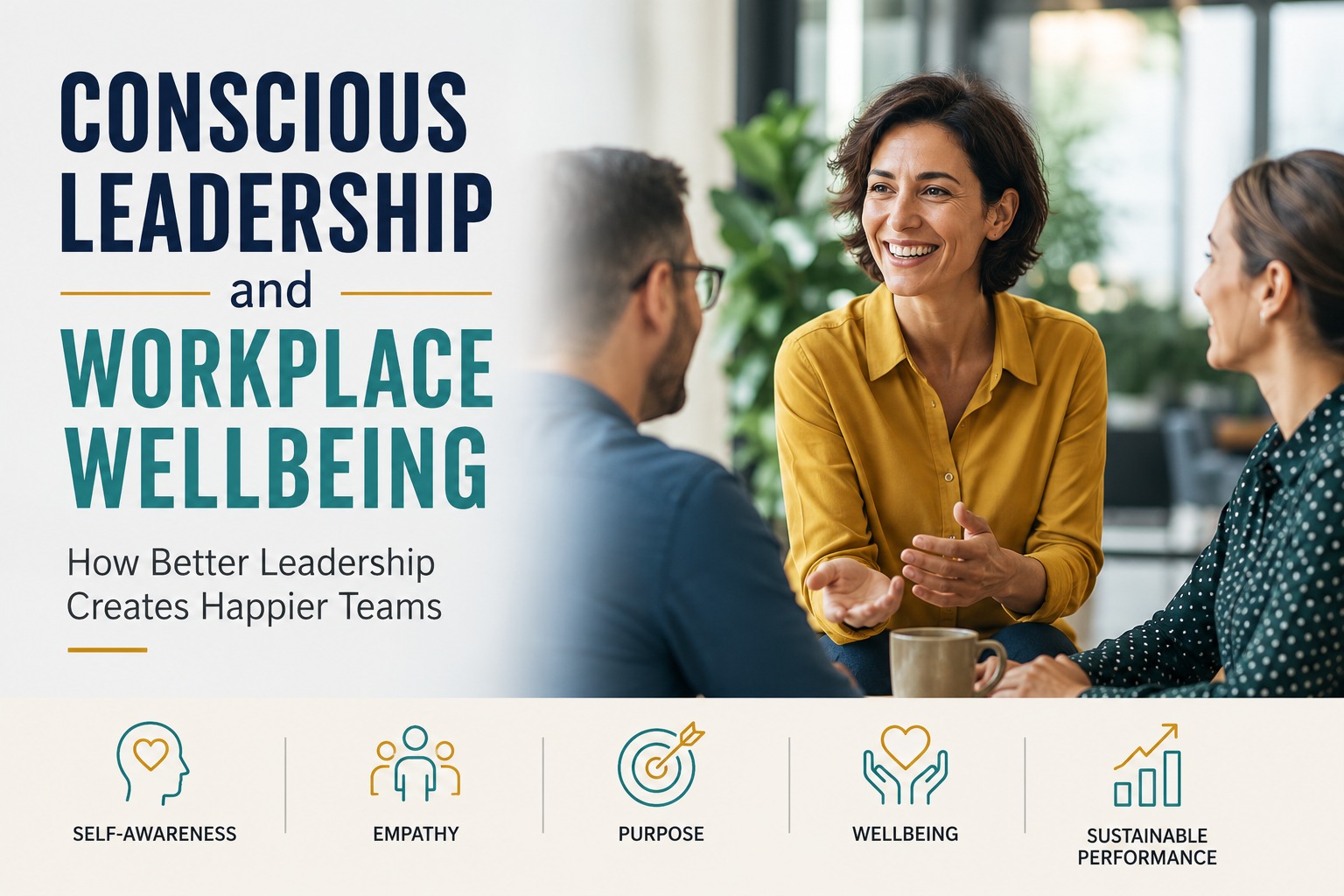
In many organisations, workplace wellbeing is treated like a benefit. A workshop is booked. A wellness app is launched. A fruit basket appears in the break room. For a while, the company feels as though it has done something meaningful.
But the truth is simpler and more important: workplace wellbeing is not built by perks. It is built by leadership.
When leaders are self-aware, emotionally intelligent, and genuinely committed to people, the culture changes. Trust grows. Stress becomes easier to manage. Communication improves. Teams feel safer, more motivated, and more willing to contribute their best work.
That is the heart of conscious leadership: leading in a way that supports both performance and human wellbeing.
What conscious leadership really means
Conscious leadership is the practice of leading with awareness. It means paying attention not only to results, but also to the impact your words, habits, and decisions have on the people around you.
A conscious leader does not simply ask, “Did we hit the target?” They also ask, “How did we get there?” and “What did this process cost our people?”
That shift matters because people do not experience work only through tasks and KPIs. They experience it through relationships, tone, pressure, recognition, fairness, and trust. A leader shapes all of those things.
At its best, conscious leadership includes:
- self-awareness
- emotional intelligence
- empathy
- clarity
- accountability
- purpose
- respect for boundaries
- a genuine interest in human growth
This is not about being soft. It is about being clear, grounded, and intentional.
Why workplace wellbeing depends on leadership
Many companies approach wellbeing as if it were separate from the business itself. In reality, wellbeing is deeply connected to how work is led every day.
If a workplace has unclear expectations, poor communication, constant urgency, or leaders who never listen, no wellbeing initiative will fully fix that. People may appreciate the effort, but they will still feel the strain of the culture beneath it.
On the other hand, when leadership is thoughtful and consistent, wellbeing becomes part of the environment rather than an extra programme.
That is why conscious leadership has such a strong effect on workplace wellbeing. It influences the daily conditions that shape employee experience:
- how safe people feel speaking up
- how fairly decisions are made
- how supported people feel during pressure
- how conflicts are handled
- how recognised people feel for their contribution
- how much space people have to think, recover, and grow
When those conditions improve, wellbeing improves with them.
The link between employee wellbeing and performance
There is still a common myth that employee wellbeing and business performance are in tension. In practice, the opposite is often true.
Healthy teams tend to be more focused, more creative, more collaborative, and more resilient. When people feel respected and supported, they are more likely to stay engaged and contribute with energy rather than exhaustion.
That does not mean work becomes effortless. It means the workplace stops draining people unnecessarily.
A strong employee wellbeing strategy does not lower standards. It creates the conditions in which people can meet higher standards sustainably.
This is where many companies make a mistake. They think wellbeing is something separate from productivity. But productivity built on chronic stress is fragile. Productivity built on trust and balance is far more durable.
Why small gestures are not enough
Many organisations rely on surface-level wellbeing actions because they are easy to launch.
Examples include:
- one-off wellness events
- mindfulness sessions with no follow-through
- motivational posters
- occasional team lunches
- access to an app that nobody uses
These actions are not useless. Some are genuinely helpful. But they are not a strategy by themselves.
If the manager still sends messages late at night, if meetings are always rushed, if feedback is harsh, and if employees never feel heard, the culture will continue to undermine wellbeing.
The deeper question is not, “What wellness activity can we offer?”
It is, “What kind of leadership experience are people having every day?”
That question is where change begins.
The core habits of conscious leaders
Conscious leadership is not a title. It is a practice.
Here are some of the habits that make it real inside an organisation.
1. They listen before they react
Conscious leaders understand that listening is not passive. It is a leadership skill.
They listen for meaning, concern, and context. They ask follow-up questions. They do not rush to defend themselves. This creates trust and reduces the emotional friction that often builds in teams.
2. They speak with clarity and respect
People feel safer when communication is direct, calm, and respectful. Conscious leaders avoid confusion, mixed signals, and unnecessary tension.
They do not use authority to create fear. They use clarity to create direction.
3. They notice the human side of work
A conscious leader knows that performance is connected to energy, emotion, and life outside work. They do not need to know every private detail of someone’s life, but they do pay attention to signs of strain, disengagement, and overload.
That awareness helps them support people earlier, before small problems become major ones.
4. They model healthy boundaries
If leaders never rest, teams learn that rest is unsafe.
If leaders respond to messages around the clock, teams assume that constant availability is expected.
Conscious leaders understand that the example they set becomes the norm others follow. Healthy boundaries are not just personal preferences. They are cultural signals.
5. They treat development as a priority
Wellbeing is not only about reducing stress. It is also about helping people grow.
Conscious leaders invest in development, coaching, feedback, and meaningful challenge. They help people feel that their work matters and that they are building something of value.
Emotional intelligence at work is a leadership advantage
Emotional intelligence at work is one of the clearest signs of strong leadership. It helps leaders understand their own behaviour, recognise the emotional state of others, and respond in ways that strengthen rather than damage the team.
An emotionally intelligent leader can:
- stay calm under pressure
- handle conflict constructively
- give feedback without humiliation
- recognise frustration before it escalates
- adapt their approach to different people
- keep the team connected during uncertainty
This matters because emotional climate spreads quickly in a workplace. A reactive leader creates reactive teams. A grounded leader creates more grounded teams.
That is why emotional intelligence should not be treated as a “nice extra.” It is a practical leadership tool with direct impact on workplace wellbeing.
What a real employee wellbeing programme should include
A meaningful employee wellbeing programme should do more than offer isolated support. It should reflect how the company actually works.
A strong programme usually includes:
Leadership practices
Managers and leaders should be trained to support wellbeing through communication, workload awareness, and emotionally intelligent behaviour.
Culture and communication
People need clarity, consistency, and psychological safety. Wellbeing improves when the culture reduces unnecessary stress.
Work design
Workload, priorities, deadlines, and meeting habits should be reviewed. Poor work design is one of the fastest ways to damage wellbeing.
Growth and recognition
People need to feel seen. Recognition, development opportunities, and fair progression all contribute to wellbeing.
Support during pressure
Teams need practical support during intense periods, not only inspirational messaging after the fact.
A wellbeing programme works best when it is woven into the way the organisation leads, not layered on top of it.
Signs your organisation needs a leadership reset
If a team is struggling, the issue is not always effort or talent. Sometimes the real problem is the leadership climate.
Here are some signs that a reset may be needed:
- people hesitate to speak honestly
- meetings feel tense or unproductive
- there is a high level of burnout or fatigue
- managers are focused only on output
- feedback feels inconsistent or personal
- employees do not feel recognised
- there is confusion about priorities
- people are quietly disengaging
These are not simply HR issues. They are leadership signals.
The good news is that they can be changed. Once leaders are willing to reflect honestly, workplace wellbeing can improve faster than many people expect.
How to build a healthier culture from the top down
A healthier workplace does not appear by accident. It is built through repeated behaviour.
Here are the foundations:
Start with self-awareness
Leaders should understand their own stress patterns, assumptions, and communication style. Self-awareness makes better leadership possible.
Make expectations clear
Ambiguity creates anxiety. Clear priorities reduce unnecessary stress and make teams feel more secure.
Reward healthy performance, not just visible busyness
Long hours are not the same thing as high-quality work. Culture should reward thoughtful contribution, not performative exhaustion.
Create room for honest feedback
People need safe ways to raise concerns. A culture that avoids truth will eventually lose trust.
Support recovery as part of performance
Rest, pause, and reflection are not luxuries. They are part of sustainable performance.
Lead with purpose
When people understand why their work matters, they are more connected, more resilient, and more engaged.
Why this matters for the future of work
The future of work will not be shaped only by technology, tools, or automation. It will also be shaped by the quality of human leadership.
Organisations that ignore wellbeing may get short-term output, but they will pay for it later through burnout, turnover, low trust, and weak culture.
Organisations that embrace conscious leadership create something stronger: teams that are healthier, more loyal, more creative, and more capable of adapting to change.
That is not just better for people. It is better for business.
Final thought
Workplace wellbeing is not a side project. It is a reflection of leadership.
When leaders are conscious, teams feel safer. When teams feel safer, they communicate better. When communication improves, trust grows. And when trust grows, performance becomes more sustainable.
That is why conscious leadership is not just a management style. It is one of the most powerful foundations for a happier, healthier, and more successful workplace.
FAQ
What is conscious leadership?
Conscious leadership is a leadership approach based on self-awareness, empathy, clarity, and intentional decision-making.
Why does workplace wellbeing matter?
Workplace wellbeing affects morale, engagement, retention, communication, and long-term performance.
Can an employee wellbeing programme improve culture?
Yes, but only when it is supported by leadership behaviour, clear communication, and healthy work design.
What is the biggest mistake companies make with wellbeing?
Treating wellbeing as a perk instead of a cultural and leadership responsibility.
How can leaders improve emotional intelligence at work?
By listening better, managing their own reactions, giving clearer feedback, and noticing the emotional impact of their decisions.
Related Post

Workplace Wellbeing: How Conscious Leadership Creates Happier, Healthier and More Successful Teams
The modern workplace has changed dramatically over the last